

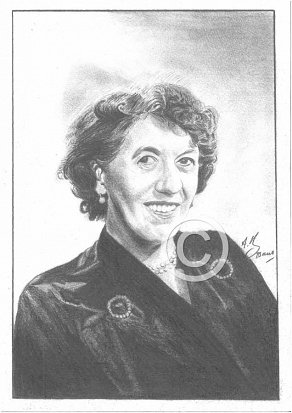
Enid Blyton
Pencil Portrait by Antonio Bosano.
Shopping Basket
The quality of the prints are at a much higher level compared to the image shown on the left.
Order
A3 Pencil Print-Price £20.00-Purchase
A4 Pencil Print-Price £15.00-Purchase
*Limited edition run of 250 prints only*
All Pencil Prints are printed on the finest Bockingford Somerset Velvet 255 gsm paper.
P&P is not included in the above prices.

Recommended viewing
Enid (BBC Tv) 2009
I tuned into this drama out of idle curiosity, sheer wonderment actually, at how the BBC would fashion a ninety minute screenplay about a seemingly innocuous woman who wrote ‘Noddy’ and regularly invited her young fans over for tea and crumpets.
Not unexpectedly, this much-anticipated screen biography of Enid Blyton depicts the dark and often melodramatic truth behind the life of one of the world’s favourite children’s authors. Authenticity is nonetheless preserved; the production meeting with the approval of Blyton’s daughter Imogen Smallwood, when she visited the film set.
Smallwood’s relationship with her mother was complex and fraught, and she was aware of her flaws. Yet ‘Enid’ is an unflinchingly honest biopic of the woman behind ‘Noddy’ and ‘The Famous Five.’ It depicts Blyton as a woman who presented her public and her family with different faces. After training as a teacher, she got her first break thanks to Hugh Pollock, who worked at the London publishers George Newnes and helped her publish her first stories in 1924.
In particular, she had an awareness of marketing, publicity and branding that was far ahead of its time. As her fame grew during the 1940s and 1950s, she launched a magazine, ‘Sunny Stories,’ aimed at her young readers, or ‘‘friends’’ as she called them. She even enlisted their help in naming Green Hedges, the Buckinghamshire country pile that her success brought her. She also oversaw the design of her books, insisting on her distinctive signature being placed on every cover. In many ways she paved the path for the literary stars of today, from Jacqueline Wilson to JK Rowling. Helena Bonham Carter, who portrayed her most convincingly – if a mite too attractively – was quick to identify her character’s primary strengths. “She was unbelievably modern. She was a complete workaholic, an achievement junkie, and an extremely canny businesswomen,” explains Bonham Carter. “She knew how to brand herself, right down to the famous signature. What I found extraordinary, bordering on insane, was the way that Enid reinvented her own life. She was allergic to reality. If there was something she didn’t like then she either ignored it or re-wrote her life.” The actress would further add that, “She didn’t like her mother, so let her colleagues assume she was dead. When her mother died, she refused to attend the funeral. Then the first husband didn’t work out, so she scrubbed him out.”
The way Blyton treated her first husband, Major Hugh Pollack, appears to have been deplorable. He was a married editor at her publishing house when she was a fledgling novelist and, in 1923, she wrote: “He’s going to fall in love with me, I want him to be mine.”
They married a year later and had Imogen and Gillian but the relationship soured. Blyton then began an affair with surgeon Kenneth Darrell Waters, who was to become her second husband.
Pollack agreed to be named as the guilty party in the divorce case to protect Blyton’s reputation, in return for access to his daughters. However, after the divorce Blyton ruthlessly cut him off from the children despite knowing how much her own father’s absence had hurt her. It hit both daughters hard.
The typewriter was her escape hatch, a portal into a fantasy world she could unceasingly fashion, whilst distancing herself from the unpalatable realities of her own life. One can only hope, for her sake – that it all seemed worthwhile in her darkest moments.
Recommended reading
Enid Blyton: The Biography ( Barbara Stoney) 1974 : Reprint 2006
A revised edition of Stoney’s original biography with an updated book listing, based on extensive research by Tony Summerfield of the Enid Blyton Society.
I picked up my copy for £2. The colour pictorial centre section with replica first edition covers was warmly evocative of a bygone era.
Five on a Treasure Island (1942)
I used to own a hard copy edition of this volume, the first outing for the Famous Five which sees them set out for Kirrin Island on their summer holidays, hunting for gold lost when George’s great-great-grandfather’s ship was wrecked decades before.
The first entry in a 22-book series, Five on a Treasure island is particularly admired for its natural descriptive qualities that clearly betray the author’s love of the southern English countryside and accompanying coastline. Like most readers, I yearned to be in the gang, a by-product of the immersive qualities of Blyton’s writing.
Comments
Last update: 17/5/15
As a brand name, novels by Enid Blyton still generate annual sales of over 450,000.
In September 2010, Hodder published revised editions of the Famous Five which modernised some of the language and the names, in order to attract a new generation of readers, although the publisher was quick to add that traditional versions would remain available. Words such as “golly,” “rather” and “awfully,” were phased out, while “Mother” and “Daddy” was replaced with “Mum” and “Dad”. A spokesman for the high street retailer, Waterstones, was quoted as saying at the time: “The way the children express themselves in Enid Blyton can be a bit alienating for children today. The way the books are written and the words that are used, are not necessarily relatable to nowadays.”
Still ever present in the annual list of top twenty best selling authors, despite the perceived dated quality of her prose, her work has endured without the added assistance of film adaptations. That’s some going, nearly fifty years after her death.
http://www.bbc.co.uk/news/entertainment-arts-12511512
Unlike the stories she so vividly evoked in her books, Blyton’s life was not a thing of gripping drama, vivid incident and intellectual ferment. Much of her time was spent sitting at a desk, churning out 10,000 words a day, and publishing 753 books over 45 years: a torrent of children’s novels, stories, poems, the long sagas of ‘the Secret Seven’ and ‘the Famous Five,’ the ‘Noddy’ books, the Angela Brazil-derived, girls-at-school books about Malory Towers and St Clare’s, the tales of magic, circuses, farms and nature. They sold 600 million copies around the world, and made her extremely rich and famous.
Her works defined escapism for the under-12s. She told stories of children escaping from mad or eccentric aunts and uncles to explore somewhere more exciting; children whose parents were unaccountably away for whole weekends, allowing them to roam, unchecked, through haunts of smugglers, kidnappers and dodgy foreigners – whom they would outsmart at the climax of the story and deliver to the hands of the local constabulary, before being rewarded with platefuls of plum cake and inevitably, lashing of ginger beer.
It is this unprecedented level of literary productivity that lies at the heart of her tarnished reputation as an unfit mother. It was Blyton’s daughter Imogen, who first shattered the illusion that her mother’s home life remotely resembled her fictional idyll, where everyone enjoyed sumptuous picnics and rumbustious adventures. She wrote a candid memoir in 1989, 21 years after her mother died, entitled “A Childhood At Green Hedges” and pulled no punches.
“The truth is, Enid Blyton was arrogant, insecure, pretentious, very skilled at putting difficult or unpleasant things out of her mind and without a trace of maternal instinct,” she wrote. “As a child, I viewed her as a rather strict authority. As an adult, I did not hate her. I pitied her.”
It is doubtful however, that Blyton engendered much pity in her first husband, the publisher Hugh Pollock. The following link, which features an interview with his third wife, the author Ida Crowe, recounts how the now successful Blyton, negotiated a scandal free divorce – despite her own adultery – whilst subsequently reneging on an agreement to allow her ex-husband full visitation rights to their two daughters. Later on, she would use her influence in publishing circles to ensure he never worked in the city again.
http://www.telegraph.co.uk/news/uknews/1410705/Adulteress-Enid-Blyton-ruined-her-ex-husband.html
By the time of her death in 1968, Blyton’s books were already facing a critical backlash from the literary world, and yet I recall my teacher announcing that – despite this press attention – fresh editions of her books would be available in the school library. By the age of eleven, I was no longer reading her works, yet she had undoubtedly fired my interest in the written word. I moved onto Fleming and the world of espionage in my teens, and that was basically it. Despite being a voracious reader, I have never really ever returned to fiction. I enjoy having my wife read to me on foreign holidays – invariably a high profile novel like “The lovely bones,” but you will be unsurprised to learn that she shows little appetite for reciprocation on my part. “White Heat – a history of Britain in the swinging sixties (1964-1970)” or “Stalingrad 1942” are not the type of volumes to be found by her sunbed. Having complained about the weight of my books for years, I am now the proud owner of a ‘kindle white’ reader which I will use on future overseas jaunts, so harmony has been restored at airport check-in desks!
She has sold more books than any other children’s author, enchanting millions of young readers with tales of adventure, ginger beer and buns.
But Enid Blyton was denied the honour of a commemorative coin after Royal Mint bosses branded the creator of the Famous Five and Secret Seven novels a ‘racist homophobe’, newly-released documents reveal.
The snub has infuriated fans of the Noddy author who insist her books – which have sold 600 million copies to date and still sell hundreds of thousands a year – have inspired generations of children to read.
The idea of a commemorative 50p coin for Blyton was discussed at a meeting of the Royal Mint’s advisory committee in December 2016.
The meeting’s minutes, obtained under freedom of information laws, reveal that members dismissed the plan because ‘she [Blyton] is known to have been a racist, sexist, homophobe and not a very well-regarded writer’.
They also reveal that the committee, which was considering producing the coin to mark the 50th anniversary of Blyton’s death in 1968, was worried about a potential backlash if members went ahead with the proposal.
The minutes state: ‘Deep concern that this theme will bring adverse reaction… concern over the backlash that may result from this.’ The committee decided to seek other subjects to celebrate.
Blyton, who published her first book in 1922 and went on to write 700 titles, is ranked seventh most successful author of all time.
In 2011, one of her previously unknown novels came to light. Called “Mr Tumpy’s Caravan,” the 180-page story about a magical caravan and the miraculous travels of its inhabitants had sat unnoticed in a pile of papers that had been bought by the Seven Stories centre in Newcastle upon Tyne.
It had languished so long because the title of the book was so similar to one of her tales published in 1949 that it was assumed to be the same one. However, it transpired that the new discovery was a completely different story by the much-loved author of Noddy, the Famous Five, the Secret Seven and The Magic Faraway Tree.
Experts might have described the book as rather “naive” and “clumsy” but in fairness it was indicative of her early work, and the find was celebrated nonetheless.
Interviewed on British television at the time, Imogen Smallwood, Enid’s younger and only living daughter, remarked that her mother would have been thrilled to know she was still widely read. “It would have been a tremendous surprise to Enid, I think,” she said.
It’s telling that Blyton’s daughter chose to call her famous mother “Enid” rather than “mum” – but by 2011, Blyton had become as synonymous with the label “bad mother” as “beloved author”. In Blyton’s own language, she was jolly horrid. It seems that Imogen wasn’t so much treated to lashings of ginger beer as aloofness and emotional neglect.
Indeed, while news of the book might have been intriguing, it was the life of the author that continued to fascinate, not least because Blyton seemed to present a dichotomy. How could a woman who brought so much joy to so many children have caused so much misery to her own daughters?
In Enid, a 2009 BBC 4 film of her life starring Helena Bonham Carter, there’s a telling scene in which an overexcited gaggle of young fans arrive at Blyton’s house to be regaled by Enid with a tea party of jelly and cake. Her own children Gillian and Imogen are excluded from the fun and have to watch the proceedings from the stairs. They were only ever wheeled out for publicity purposes.
Tapping out 10,000 words every day and 23 books a year left little time for playing happy families, despite what the novelist claimed publicly. “Dear boys and girls,” she once wrote. “As you can imagine, we’re a happy little family. I could not possibly write a single book if I were not happy with my family and I put them first and foremost.”
It was Imogen, now in her mid eighties, who shattered the illusion that Blyton’s home life remotely resembled her fictional idyll where everyone enjoyed sumptuous picnics and rumbustious adventures. She wrote a candid memoir in 1989, 21 years after her mother died, entitled A Childhood At Green Hedges and she pulled no punches.
“The truth is, Enid Blyton was arrogant, insecure, pretentious, very skilled at putting difficult or unpleasant things out of her mind and without a trace of maternal instinct,” she wrote. “As a child, I viewed her as a rather strict authority. As an adult, I did not hate her. I pitied her.”
She debunked the popular myth that Blyton would read her famous tales to her daughters. “This is quite untrue,” countered Imogen, adding: “Most of my mother’s visits to the nursery were hasty, angry ones, rather than benevolent. The nursery was a lonely place. The nannies lingered in the warm kitchen and I had no friends to play with.”
According to Imogen, Blyton only wanted a relationship with children through her books. “Those were her best friends. Real children were an intrusion. I found her very cold and saw little of her. She didn’t mean to be cold. The world she was living in was too important to her to embrace those who intruded on her.”
To be fair, Blyton’s other daughter, Gillian, painted a different picture. Gillian, who died in 2007, maintained: _“My mother always seemed to have time for me. We would go to glorious buttercup meadows. We would go blackberrying. I was always doing things with her.”
_
In later years, the two sisters bickered over the “truth” about their mother but Gillian did concede she was the favoured sister.
B lyton’s own upbringing was hardly a happy one. She was born in East Dulwich, London, in 1897, the oldest child of a cutlery salesman. Idolising her father, she was devastated when her parents split and he left home.
Imogen believes her mother was “emotionally crippled” by this abandonment at the age of 12 and this has been corroborated by Barbara Stoney, Blyton’s biographer. “Stoney suggested the trauma she suffered was so huge that a lot of her emotional development just froze there and I think this is a very good way of looking at her,” Imogen has said. Strangely, when Blyton was having difficulty conceiving in later life she visited a gynaecologist who told her she had an underdeveloped uterus “like that of a 12 or 13-year-old girl.” She needed hormone injections to conceive.
“What I found extraordinary, bordering on insane, was the way that Enid reinvented her own life,” Helena Bonham Carter has commented. “She was allergic to reality. If there was something she didn’t like then she either ignored it or re-wrote her life.
“She didn’t like her mother, so let her colleagues assume she was dead. When her mother died, she refused to attend the funeral. Then the first husband didn’t work out, so she scrubbed him out.”
The way Blyton treated her first husband, Major Hugh Pollack, appears to have been deplorable. He was a married editor at her publishing house when she was a fledgling novelist and, in 1923, she wrote: “He’s going to fall in love with me, I want him to be mine.”
They married a year later and had Imogen and Gillian but the relationship soured. Blyton then began an affair with surgeon Kenneth Darrell Waters, who was to become her second husband.
Pollack agreed to be named as the guilty party in the divorce case to protect Blyton’s reputation, in return for access to his daughters. However, after the divorce Blyton ruthlessly cut him off from the children despite knowing how much her own father’s absence had hurt her. It hit both daughters hard.
“I remember going down to the station with him, just before my 10th birthday and I remember leaving the station with tears in my eyes,” Gillian once recalled. “I never saw him again.” Even as an adult Gillian stuck to her mother’s “no contact” rule.
“Years later, I learnt that he had heard about my wedding, read about it in the papers and came to the church secretly and stood across the road and watched over me on my wedding day. I thought of naming my first son after him but I realised it would have hurt my mother, so I didn’t. Once she had died I did try to find him. He was living in Malta with his new wife and daughter but I was too late to see him. He died two weeks after I found out where he was.”
According to Pollack’s widow, Ida Crowe, Blyton also vindictively used her clout as a famous author to prevent him from finding more publishing work. He went bankrupt and sank into depression and drinking.
One wonders what Blyton’s own response would be to the criticism she has received today. It has not all been about her personality, either. Her writing, while helping to shape the imagination of millions of children, has been beset with rows over racism, sexism, xenophobia and snobbery.
During her lifetime, Blyton’s response to any disparagement was always to state she wasn’t interested in the views of any critics over the age of 12.
To date, she has sold more than 600 million books and still sells about eight million copies a year. She might, one suspects, be satisfied with that.